


For millions of patients dealing with chronic fatigue, autoimmune flare-ups, unexplained weight gain, and persistent digestive issues, specialty lab testing is a crucial turning point. Tests like the DUTCH Test (Dried Urine Test for Comprehensive Hormones), the GI-MAP (Gastrointestinal Microbial Assay Plus), and comprehensive Bio-Identical Hormone Panels reveal deep biochemical insights that standard annual bloodwork routinely misses.
However, sticker shock often halts patient care. A single functional medicine lab kit can run anywhere from $250 to $800 out-of-pocket, and a complete diagnostic protocol can easily exceed $1,500. When patients hand these specialty kits to their health insurance providers, they are frequently met with outright claim denials, leaving them to bear the financial brunt alone.
The common belief is that health insurance simply “doesn’t cover functional medicine.” The truth is more subtle: health insurance operates on rigid coding systems, diagnostic necessity rules, and billing networks. By understanding how insurance reimbursement works, leveraging HSA/FSA funds correctly, utilizing superbills, and ordering through specific lab networks, you can significantly lower your out-of-pocket costs for functional medicine testing.
The Insurance Reality: Why Specialty Labs Get Denied
To get insurance coverage for functional medicine labs, you must first understand why insurance companies deny these claims in the first place.
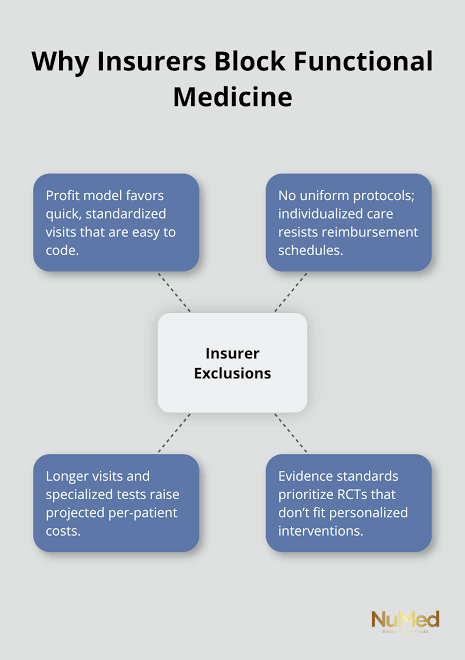
1. “Experimental” vs. “Medically Necessary” Classification
Insurance companies evaluate medical claims based on Medical Necessity Guidelines. Standard insurance carriers rely on traditional clinical guidelines that prioritize acute disease diagnosis over sub-clinical optimization.
- Specialty labs (like DNA-based stool testing or urinary hormone metabolite testing) are often flagged as “investigational,” “experimental,” or “unproven” by major insurance medical boards—even when supported by extensive peer-reviewed literature.
2. Out-of-Network Lab Facilities
Most functional lab companies (such as Diagnostic Solutions Laboratory, Precision Analytical, or Genova Diagnostics) operate as specialized, independent laboratories. Many do not maintain direct in-network billing contracts with standard commercial insurers like Aetna, BlueCross BlueShield, Cigna, or UnitedHealthcare.
3. Missing ICD-10 Diagnosis Codes
Insurance billing relies on two core sets of codes:
- ICD-10 Codes (Diagnosis): The medical reason or symptom justifying the test.
- CPT Codes (Procedure): The specific laboratory process performed.
If a practitioner submits a lab order using general wellness codes (e.g., Z00.00 for a general adult checkup), insurance will automatically deny specialty testing. Insurance does not cover exploratory testing; it only covers testing that directly investigates documented clinical symptoms.
Specialty Lab Cost Breakdown & Typical Insurance Status
| Specialty Lab Test | Primary Purpose | Average Retail Cash Price | Standard Insurance Coverage Status | Best Financial Reimbursement Strategy |
| GI-MAP (Stool Test) | Quantitative DNA analysis of gut microbiome, pathogens, parasites, and digestive markers. | $350 – $500 | Rarely covered directly; out-of-network reimbursement possible. | Submit a detailed Superbill using CPT 87500 series with specific GI diagnosis codes. |
| DUTCH Test (Hormones) | Comprehensive urinary adrenal cortisol slope, sex hormones, and organic acid metabolites. | $300 – $650 | Denied as “experimental” by most commercial plans. | Pay cash rate; submit for HSA/FSA reimbursement with a Letter of Medical Necessity (LMN). |
| Comprehensive Thyroid Panel | Full TSH, Free T3, Free T4, Reverse T3, and TPO/Tg Antibodies. | $150 – $400 | High Potential for 80%–100% coverage if ordered correctly. | Have a licensed NPI doctor order through Quest Diagnostics or Labcorp in-network. |
| Bio-Identical Hormone Panel | Serum estradiol, progesterone, free/total testosterone, DHEA-S, SHBG. | $200 – $450 | High Potential when coded with specific menstrual or endocrine symptoms. | Run through standard in-network diagnostic labs using covered diagnostic ICD-10 codes. |
| Organic Acids Test (OAT) | Metabolic evaluation of mitochondrial function, neurotransmitter metabolites, and candida. | $300 – $450 | Low coverage; mostly considered out-of-network. | HSA/FSA payment or out-of-network post-service claim submission. |
4 Actionable Strategies to Get Insurance Reimbursement
Strategy 1: The Dual-Lab Hybrid Approach (Split Your Testing)
One of the most effective ways to lower costs is to split your lab orders between in-network commercial labs and specialty functional labs.
- Step 1: Have your functional medicine practitioner write an order for all standard markers—such as comprehensive metabolic panels (CMP), lipid panels, full thyroid profiles, vitamin D, fasting insulin, and inflammation markers (hs-CRP)—to be drawn at an in-network facility like Quest Diagnostics or Labcorp.
- Step 2: Ensure your doctor attaches symptomatic ICD-10 codes (such as
R53.83for Chronic Fatigue,E03.9for Hypothyroidism, orK59.00for Constipation). When ordered this way, these comprehensive tests are billed directly to your insurance and are usually covered under standard diagnostic benefits. - Step 3: Reserve your cash budget exclusively for the true specialty tests (like the GI-MAP or DUTCH test) that cannot be run through standard commercial labs.
Strategy 2: The Superbill Submission Process
If you pay out-of-pocket for a specialty lab kit upfront, you can request a Superbill from your treating physician. A Superbill is an itemized receipt that contains official billing data required by insurance companies:
- Provider’s NPI (National Provider Identifier) and Tax ID.
- Specific CPT Codes for every lab component.
- Specific ICD-10 Diagnosis Codes matching your clinical symptoms.
How to Submit a Superbill Correctly:
- Pay the cash rate upfront to your practitioner or the laboratory.
- Request an official Superbill upon completion of the test.
- Download a Member Claim Form (Member Submitted Claim) directly from your health insurance portal.
- Attach the Superbill and lab invoice to the claim form.
- Mail or upload the claim to your insurer’s Out-of-Network Claims Department.
If you have out-of-network benefits (common with PPO insurance plans), your insurer may apply the cost toward your out-of-network deductible or issue a direct partial reimbursement check.
Strategy 3: Maximize Tax-Advantaged Accounts (HSA & FSA)
Even if your insurance plan denies coverage on a claim, Health Savings Accounts (HSA) and Flexible Spending Accounts (FSA) legally allow you to use pre-tax dollars to pay for functional medicine labs, saving you roughly 20% to 35% depending on your tax bracket.
To ensure your HSA/FSA administrator does not flag or reject the expense:
- Obtain a Letter of Medical Necessity (LMN): Ask your ordering clinician to write a formal LMN. This one-page document states your current symptoms, relevant medical history, and explicitly certifies that the requested lab (e.g., DUTCH or GI-MAP) is medically required to guide your treatment plan.
- Keep Itemized Receipts: Retain both the laboratory invoice detailing the specific test name and the corresponding payment transaction record.
Strategy 4: Utilize “Direct-to-Consumer” Lab Aggregators
If you lack out-of-network insurance benefits or carry a high deductible, ordering tests through direct-to-consumer lab portals (such as Rupa Health, Ulta Lab Tests, or Request A Test) can offer significant savings. These platforms negotiate wholesale pricing with major diagnostic facilities, allowing cash-paying patients to access comprehensive panels at 50% to 80% below traditional hospital retail rates.
Essential CPT & ICD-10 Codes for Common Functional Labs
When discussing insurance options with your clinician, reference these specific billing codes to ensure your paperwork is structured for optimal insurance processing.
                          [ Clinical Symptoms Present ]
                                       |
                                       v
                   [ Doctor Selects Symptomatic ICD-10 Code ]
                     (e.g., K59.00 Constipation / R53.83 Fatigue)
                                       |
                                       v
                     [ Lab Match with Valid CPT Code ]
                     (e.g., CPT 87500 for Stool Pathogen DNA)
                                       |
                                       v
           +---------------------------+---------------------------+
           |                                                       |
 [ In-Network Commercial Lab ]                           [ Specialty Out-of-Network Lab ]
 (Quest / Labcorp)                                       (GI-MAP / DUTCH)
           |                                                       |
           v                                                       v
( Direct Insurance Billing )                              ( Pay Cash + Submit Superbill )
1. GI-MAP & Advanced Stool Analysis
- Common CPT Codes:
87500(Infectious agent detection by nucleic acid, GI panel),87798(DNA amplification),82272(Occult blood testing). - Supporting ICD-10 Codes:
K59.00(Constipation),K59.1(Functional Diarrhea),R14.0(Abdominal distension/bloating),K58.9(Irritable Bowel Syndrome).
2. DUTCH & Comprehensive Hormone Profiles
- Common CPT Codes:
82670(Estradiol),84144(Progesterone),84403(Testosterone),82308(Dehydroepiandrosterone / DHEA),82530(Cortisol testing). - Supporting ICD-10 Codes:
N94.6(Dysmenorrhea),N95.1(Menopausal/Perimenopausal status),E28.2(Polycystic Ovary Syndrome – PCOS),R53.83(Other fatigue).
Step-by-Step Patient Action Plan
- Call Your Insurance Member Services Line: Before taking any test, call the customer service number on the back of your insurance card. Ask specifically: “What are my out-of-network diagnostic laboratory benefits?” and “Does my policy exclude out-of-network reference lab coverage?”
- Ask Your Clinician for a Superbill in Advance: Confirm that your treating physician is willing to provide a complete Superbill with NPI, CPT codes, and ICD-10 codes upon ordering your labs.
- Run All Standard Bloodwork In-Network: Never pay out-of-pocket for routine blood markers (iron panels, basic thyroid, metabolic panels). Have your practitioner send these orders directly to an in-network facility.
- Obtain a Letter of Medical Necessity (LMN): Secure an signed LMN from your doctor prior to purchasing specialty kits out-of-pocket to safeguard your HSA/FSA reimbursement.
- Keep Clean Digital Records: Scan and archive copies of your original lab order, itemized receipts, Superbills, and claim submission confirmations.
Frequently Asked Questions (FAQs)
Why doesn’t my insurance automatically cover the GI-MAP or DUTCH test?
Major insurance carriers evaluate tests against their internal clinical coverage guidelines. Because specialized tests evaluate functional imbalances rather than acute diseases, insurers frequently label them “investigational” or “not medically necessary,” regardless of their clinical utility.
Can my Primary Care Physician (PCP) order functional medicine labs for me?
Yes. If your PCP is a licensed MD, DO, or Nurse Practitioner, they can legally order functional medicine lab kits. If they order these tests and submit them with valid, symptom-based ICD-10 codes, your chances of obtaining partial out-of-network coverage or securing smooth HSA/FSA approval are significantly higher.
What is a Superbill, and how do I get one?
A Superbill is an itemized medical invoice detailing the specific diagnostic codes (ICD-10), procedure codes (CPT), cost, and provider details (NPI/Tax ID) for a medical service. You can request a Superbill directly from your ordering physician’s office or billing department after paying for your test.
What should I do if my insurance claim is denied?
If your submitted Superbill claim is denied, file a formal Level 1 Internal Appeal. Submit a copy of your doctor’s Letter of Medical Necessity (LMN), relevant peer-reviewed studies supporting the test’s clinical validity, and your complete clinical notes detailing why standard medical diagnostics were insufficient to identify your condition.
Can I use my FSA or HSA card to purchase functional lab kits online?
Yes. Functional medicine labs qualify as eligible medical expenses under IRS guidelines provided they are ordered by a licensed healthcare provider to diagnose or treat a specific symptom or health condition. Always keep your itemized receipt and an LMN on file in case of an HSA audit.
Find Verified Functional Medicine Practitioners
Navigating insurance rules and specialty diagnostics is easier alongside a knowledgeable healthcare partner. Working with a practitioner experienced in insurance coding and root-cause medicine ensures you get the testing you need without paying unnecessary fees.
Are you looking for experienced functional medicine doctors, integrative physicians, or naturopathic specialists near you? Search the Wellness Directory USA to find verified root-cause practitioners in your area.
Disclaimer: The content provided in this article is for informational and educational purposes only and does not constitute formal legal, tax, or medical advice. Insurance coverage policies, CPT codes, and reimbursement rates vary widely by state, insurer, and individual plan. Always verify your specific benefits directly with your health insurance provider prior to undergoing specialty testing.
